

Before you hire that driver, what was his driving history on his
last job, or in another state? Low cost Driving Record/Motor Vehicle Record checks are
provided for every state in the US and Canada. Click Here to Order Now.
For your insurance company's requirements, or for your own
peace of mind, let us check the driving record of anyone who drives company vehicles.
Driving record checks are nationwide (where permitted by
law).
Turn-around Time: 2 Business Days
... except for the states which require consent forms or mail-in forms. Rush Service available for some states.
Here's what our customers are saying:
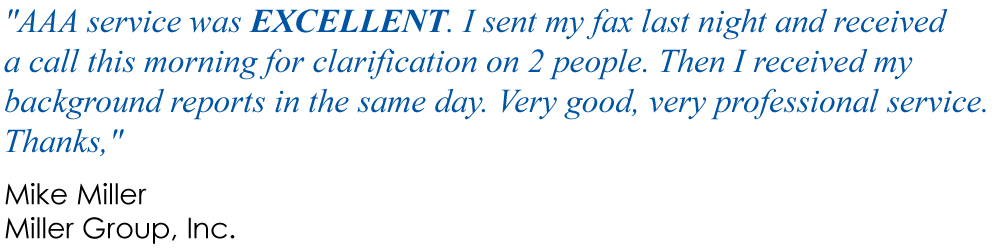
"AAA service was EXCELLENT. I sent my fax last night and got a call this morning for clarification on 2 people. Then I received my reports in the same day. Very good, very professional service. Thanks,"
Mike Miller
Miller Group, Inc.
There is never a sign-up fee to use our services! Call our
friendly staff, toll free at 1-888-282-0447, 8 AM to 6PM Central time, Monday through
Friday, or Saturday 9 AM to 4 PM, for more information and an exact quote on the services you need.
Some employers routinely run background checks on applicants or current employees. But there are some legal limits on the information you can gather and use when making employment decisions.
When you are making hiring or promotion decisions, you might need a bit more information than your employees provide. After all, some folks do give false or incomplete information in employment applications. And workers probably don't want you to know certain facts about their past that might disqualify them from holding a new position. Generally, it's good policy to do a little checking before you make these important decisions.
However, you do not have an unfettered right to dig into applicants' or employees' personal affairs. Workers have a right to privacy in certain personal matters, a right they can enforce by suing you if you pry too deeply. How can you avoid crossing this line? Here are a few tips to keep in mind:
Make sure your inquiries are related to the job. If you decide to do a background check, stick to information that is relevant to the job for which you are considering the worker. For example, if you are hiring a security guard who will carry a weapon and be responsible for large amounts of cash, you might reasonably check for past criminal convictions. If you are hiring a seasonal farm worker, however, a criminal background check is probably unnecessary.
Ask for consent. You are on safest legal ground if you ask the applicant or worker, in writing, to consent to your background check. Explain clearly what you plan to check on and how you will gather information. This gives the worker the opportunity to take herself out of the running if there is something in her past she wants to keep private. It also prevents the worker from later claiming that her privacy was unfairly invaded. If a worker refuses to consent to a reasonable request for information, you may legally decide not to hire the worker on that basis.
Be reasonable. Employers can get in legal trouble if they engage in overkill. You will not need to perform an extensive background check on every applicant. Even if you decide to check, you probably won't need to get into excessive detail for every position. If you find yourself questioning neighbors, ordering credit checks and performing exhaustive searches of public records every time you hire a clerk or counterperson, you need to scale it back.
In addition to these general considerations, specific rules apply to certain types of information, like:
School records. Under federal law and the law of some states, educational records -- including transcripts, recommendations and financial information -- are confidential. Because of these laws, most schools will not release records without the consent of the student. And some schools will only release records directly to the student.
Credit reports. Under the Fair Credit Reporting Act or FCRA (15 U.S.C. §1681), employers must get an employee's written consent before seeking that employee's credit report. Many employers routinely include a request for such consent in their employment applications. If you decide not to hire or promote someone based on information in the credit report, you must give the person a copy of the report and tell them of their right to challenge the report under the FCRA. Some states have more stringent rules limiting the use of credit reports.
Bankruptcies. Federal law prohibits employers from discriminating against applicants because they have filed for bankruptcy. This means you cannot decide not to hire someone simply because they have declared bankruptcy in the past.
Criminal records. The law varies from state to state on whether, and to what extent, a private employer may consider an applicant's criminal history in making hiring decisions. Some states prohibit employers from asking about arrests, convictions that occurred well in the past, juvenile crimes or sealed records. Some states allow employers to consider convictions only if the crimes are relevant to the job. And some states allow employers to consider criminal history only for certain positions: nurses, childcare workers, private detectives and other jobs requiring licenses, for example. Because of this variation, you should consult with a lawyer or do further legal research on the law of your state before digging into an applicant's criminal past.
Workers' Compensation records. An employer may use the information contained in the public record from a Workers' Compensation Appeal only if the injury in question might interfere with the applicant's or worker's ability to perform required duties.
Other medical records. Under the Americans with Disabilities Act or ADA (42 U.S.C. §12101 and following), employers may inquire only about an applicant's ability to perform specific job duties -- they may not request an employee's medical records. An employer may not make a job decision (on hiring or promotion, for example) based on an employee's disability. (For tips on how to avoid this, see How to Comply With the Americans with Disabilities Act When Hiring New Employees.) Some states also have laws protecting the confidentiality of medical records.
Records of military service. Members and former members of the armed forces have a right to privacy in their service records. These records may be released only under limited circumstances, and consent is generally required. However, the military may disclose name, rank, salary, duty assignments, awards and duty status without the member's consent.
Driving records. An employer should check the driving record of any employee whose job will require large amounts of driving (delivery persons or bus drivers, for example). These records are available, sometimes for a small fee, from the state's Department of Motor Vehicles. These records are not confidential, and can be released without the driver's consent.